
How to Pay for Senior Living: What Families Should Know About Private Pay, Long-Term Care Insurance & Other Resource

One of the first questions families often ask when considering senior living is:

“How are we going to pay for this?”
It is an understandable question.
The cost of independent living, assisted living, or memory care can feel overwhelming—especially when a family is making the decision quickly because of a hospitalization, rehabilitation stay, change in health, caregiver burnout, or concerns about safety at home.
The good news is that families may have more than one financial resource available to them.
Understanding those resources before choosing a community can help families make a more informed decision and avoid focusing solely on the monthly price.

At GEMSI Senior Living Advisors, we help families look at the bigger picture: care needs, location, lifestyle, community fit, available resources, and affordability.

Important: GEMSI provides senior-living navigation and placement guidance. We do not provide financial, tax, legal, or benefits advice. Families should consult the appropriate licensed professional or government agency regarding their individual circumstances.

First, Understand What You're Paying For

Senior living is not one single type of service.
The cost can vary significantly depending on whether someone needs:

● Independent living
● Assisted living
● Memory care
● Respite or short-term senior living
● Additional personal care
● Medication assistance
● Incontinence care
● Transportation
● Specialized dementia support

A community may advertise a base monthly rate, but additional services can increase the actual monthly cost.
That’s why families should ask:
“What is included in the monthly rate, and what costs extra?”

Understanding the total cost of living is more useful than comparing advertised base rents alone.

1. Private Pay: The Most Common Funding Source

1. Private Pay: The Most Common Funding Source
This may include:

● Social Security income
● Pension income
● Retirement accounts
● Savings
● Investment accounts
● IRA distributions
● Other personal income
● Proceeds from selling a home
● Family contributions

Private-pay senior living generally means the resident or family is responsible for paying the community directly

Why planning matters

Families sometimes wait until a crisis occurs before looking at their financial options.
That can make the process significantly more stressful.
If senior living is becoming a possibility, it can be helpful to determine:
“What monthly amount can realistically be sustained?”
Instead of asking only:
“What can we afford today?”
consider:
“What can we reasonably afford over the next several years?”

This is particularly important when considering memory care, where care needs may change over time.

2. Long-Term Care Insurance

If your loved one has a long-term care insurance policy, don’t assume it will not cover senior living.
However, policies differ considerably.
Families should review:

● Benefit amount
● Elimination or waiting period
● Covered levels of care
● Benefit duration
● Daily or monthly maximum
● Inflation protection
● Eligibility requirements
● Required documentation
● Whether the community meets policy requirements

Some policies may require a physician or other qualified professional to certify that the insured person meets specific eligibility criteria.
A helpful step
Call the insurance company and ask:
“What benefits are available if my loved one moves into an assisted living or memory care community?”
Ask the insurer to explain the requirements and documentation needed before making assumptions about coverage.

3. Veterans Benefits

Veterans and surviving spouses may qualify for certain benefits that can help with long-term care expenses.
One benefit families may hear about is VA Aid and Attendance.
Eligibility depends on factors such as military service, disability, financial circumstances, and care needs.
Because VA benefits can be complicated, families should verify eligibility directly with the Department of Veterans Affairs or a qualified veterans benefits professional.
Questions to ask
If your loved one or their spouse served in the military, ask:

● What military service qualifies?
● Is there a VA benefit that applies to our situation?
● Does assisted living or memory care qualify?
● What documentation is required?
● How long does the application process typically take?

Don’t overlook veteran status when evaluating senior living finances.

4. Home Equity

For homeowners, the family home may represent a significant financial resource.
Possible strategies may include:

● Selling the home
● Renting the home
● Using existing home equity
● Other home-equity-based financial arrangements

However, these decisions can have significant tax, estate-planning, mortgage, and family implications.

For that reason, families should consult an appropriate financial, tax, legal, or real-estate professional before making a major decision involving the home.
One important question
If your loved one moves permanently into senior living:
“Does keeping the house still make financial sense?”
There isn’t one universal answer.
Some families may want to keep the home for a spouse or other family member. Others may determine that selling it provides the resources needed to fund ongoing care.

5. Medicaid/Medi-Cal: Understand the Difference

This is an area where families can become confused.
Medicare and Medi-Cal are not interchangeable.
Medicare generally should not be viewed as a program that simply pays the monthly cost of room and board in a typical assisted living or memory care community.
California’s Medi-Cal program may provide certain long-term services and supports for people who meet applicable eligibility requirements, and some programs can help cover specific services in qualifying settings.
Eligibility and coverage depend on the individual, program, setting, services, and current rules.
Don’t assume someone qualifies—or doesn’t qualify.
If Medi-Cal may be relevant to your family, consider speaking with:

● A Medi-Cal eligibility specialist
● An elder-law attorney
● A qualified benefits professional
● The appropriate California county or state agency

GEMSI can help families identify questions to ask and understand the senior-living options available, but benefits eligibility should be verified with the appropriate source.

6. Medicare: Know What It Generally Doesn't Do

Families sometimes hear:
“Medicare will pay for assisted living.”
That statement can create unrealistic expectations.
Medicare is generally not designed to pay the ongoing room-and-board cost of a typical assisted living or memory care residence.
Medicare may cover certain healthcare services when eligibility requirements are met, but that is different from paying a senior living community’s monthly residential charge.
For example, a resident may potentially receive covered medical services while living in a senior living environment without Medicare paying the entire cost of the residence.
This distinction is important when creating a realistic financial plan.

7. Family Contributions

In some families, adult children or other relatives contribute toward a loved one’s senior living expenses.
This can be helpful—but it should be approached carefully.
Before agreeing to contribute, families should discuss:

● How much each person can realistically contribute
● How long the contribution can continue
● Who will handle payments
● What happens if the cost increases
● What happens if the resident’s care needs change
● Whether contributions affect other family financial obligations

A written family agreement may help avoid misunderstandings.
When substantial assets or ongoing financial obligations are involved, professional legal or financial advice can be valuable.

8. Respite Care Can Be a Financial Planning Tool

Not every senior living decision needs to begin with a permanent move.
Respite care may allow a family to arrange a short-term stay while they determine what should happen next.
This can be useful when:

● A caregiver needs temporary relief
● A senior is recovering after hospitalization or rehabilitation
● The family needs time to prepare the home
● A caregiver is temporarily unavailable
● The family is unsure whether permanent senior living is appropriate
● The family wants to evaluate how the older adult responds to a senior living environment
A short-term stay may also give families time to organize finances, evaluate communities, and have important conversations without making a permanent decision during a crisis.
GEMSI’s Respite Placement Program™ is designed to help families identify participating communities that offer appropriate short-term senior living options.

9. Don't Compare Communities Based on Rent Alone

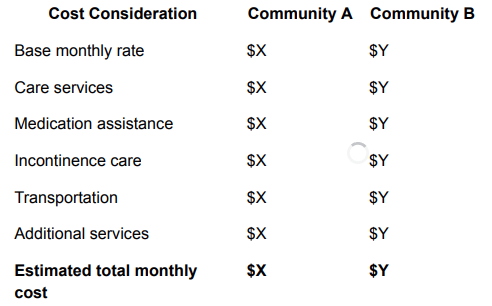
A community with a lower base rate isn’t necessarily the least expensive option.
Consider the total monthly cost.
For example:
The community with the lower advertised rent could ultimately cost more after additional services are included.
That’s why GEMSI encourages families to ask for a complete fee schedule and understand how the community’s care pricing works.

10. Ask What Happens When Care Needs Increase

This is one of the most important financial questions families can ask.
Your loved one’s needs today may not be the same six months or two years from now.
Ask:

“If my loved one’s care needs increase, how will the monthly cost change?”

Also ask:

● Is there a tiered care system?
● Is there a maximum care level?
● Are there additional fees for dementia-related care?
● Does the community offer memory care?
● What happens if the resident eventually requires a higher level of care?
● Are there circumstances under which the resident would need to move?

Understanding the community’s pricing model before move-in can prevent unpleasant surprises later.

Create a Senior Living Financial Snapshot

Before touring communities, consider creating a simple financial snapshot

Monthly Income
● Social Security: $________
● Pension: $________
● Retirement distributions: $________
● Investment income: $________
● Other income: $________
Total monthly income: $________
Available Resources
● Savings: $________
● Checking: $________
● Retirement assets: $________
● Investments: $________
● Home equity: $________
● Long-term care insurance: $________
● Veterans benefits: $________
● Other resources: $________
Potential Monthly Senior Living Budget
Target monthly budget: $________
This isn’t a substitute for professional financial planning.

It is simply a starting point that can help families understand the parameters they are working with.

Questions to Ask a Senior Living Community About Money

Before making a decision, ask:

Pricing
1. What is the base monthly rate?
2. What is included?
3. What services cost extra?
4. Is there a one-time community or entrance fee?
5. Is there a security deposit?
6. Are there annual increases?
7. How often are rates reviewed?
Care
8. How is care priced?
9. What happens if care needs increase?
10. Are medication management services included?
11. Are there additional memory care fees?
12. Are there separate charges for incontinence assistance?
Contract
13. What is the minimum commitment?
14. What happens if the resident needs to leave?
15. What happens to deposits?
16. What happens if the resident is hospitalized?
17. Is there a temporary absence policy?
Financial Planning
18. Does the community accept long-term care insurance?
19. Does the community work with VA beneficiaries?
20. Are there resources available to help families understand payment options?

Getting answers in writing can make it easier to compare communities accurately.

The Goal Isn't Simply to Find the Cheapest Community

Senior living is about more than monthly rent.
A lower-cost community may not provide the location, care level, environment, activities, staffing model, or services your loved one needs.
At the same time, the most expensive community isn’t automatically the best choice.
The goal is to find a community that offers an appropriate balance of:

Care + Safety + Lifestyle + Location + Quality + Affordability

That’s where individualized senior-living navigation can be valuable.

How GEMSI Helps Families Navigate the Financial Side of Senior Living

GEMSI Senior Living Advisors does not provide financial advice.
What we can do is help families understand the senior-living marketplace and organize the information they need to make a more informed decision.
Our process may include:

1. Understand
We learn about your loved one’s care needs, preferences, lifestyle, location, and circumstances.
2. Establish a Budget Range
We help families identify a realistic senior-living budget to use when evaluating communities.
3. Identify Appropriate Options
We help identify independent living, assisted living, memory care, or respite options that appear
aligned with the family’s needs and budget.
4. Compare the Real Costs
We help families look beyond the advertised base rate and ask about additional fees and
care-related expenses.
5. Tour
We help coordinate community tours so families can evaluate their options firsthand.
6. Evaluate
We help families compare what they learn from each community.
7. Transition
Once the family selects a community, we help navigate the next steps toward the move.

A Financial Decision Doesn't Have to Become a Crisis Decision

Sometimes families begin exploring senior living months before a move is necessary.
That’s often ideal.
Other times, the decision comes suddenly:

A hospitalization.
A fall.
A caregiver crisis.
A diagnosis.
A rehabilitation discharge.
A change in cognitive functioning.

When that happens, families may feel pressured to make a major financial and residential decision in a matter of days.
You don’t have to know all the answers immediately.
Start by understanding:

What does my loved one need?
What can we realistically afford?
What resources might be available?
What communities can meet those needs?
What happens if their needs change?

Those questions can transform an overwhelming decision into a structured process.

Those questions can transform an overwhelming decision into a structured process.

Choosing senior living is both a care decision and a financial decision
The right community should not only meet your loved one’s needs today—it should also make sense for your family’s circumstances and long-term plan.
GEMSI Senior Living Advisors helps families navigate independent living, assisted living, memory care, and respite options throughout the Inland Empire and surrounding Southern California communities.
We help families understand their options, compare communities, and move forward with greater clarity and confidence.
GEMSI Senior Living Advisors
Felicia Igbinosa | Executive Director / Senior Living Advisor
951.965.9330
felicia@gemsiadvisors.com
A trusted resource. A compassionate partner. Better outcomes for families.

SPEAK WITH AN ADVISOR

We begin by getting to know the individual, their needs, preferences, circumstances, and priorities.

or

Call Us: 951.965.9330

We're here to help.